
Inside the building
Four benches, one mortiser, eleven people
We took the unit on Whitworth Street West in the spring of 2024 because it had three phase power, a goods door wide enough for a bench, and a landlord who did not mind the noise.
Boudu Chairworks is eleven people: four on the benches, one in the machine shop, two finishing, one upholstering seats, two in the office and Martin, who still cuts tenons when a job is late.
Nothing about the way we work is unusual. It is the way chairs were made before frames were stapled together, and it survives because a jointed chair can be taken apart and put back together in twenty years, while a glued and screwed one goes in a skip.
Anyone is welcome to come and look. Ring ahead on 0161 236 7716 so somebody is free to walk round with you, and wear shoes you do not mind getting sawdust on.
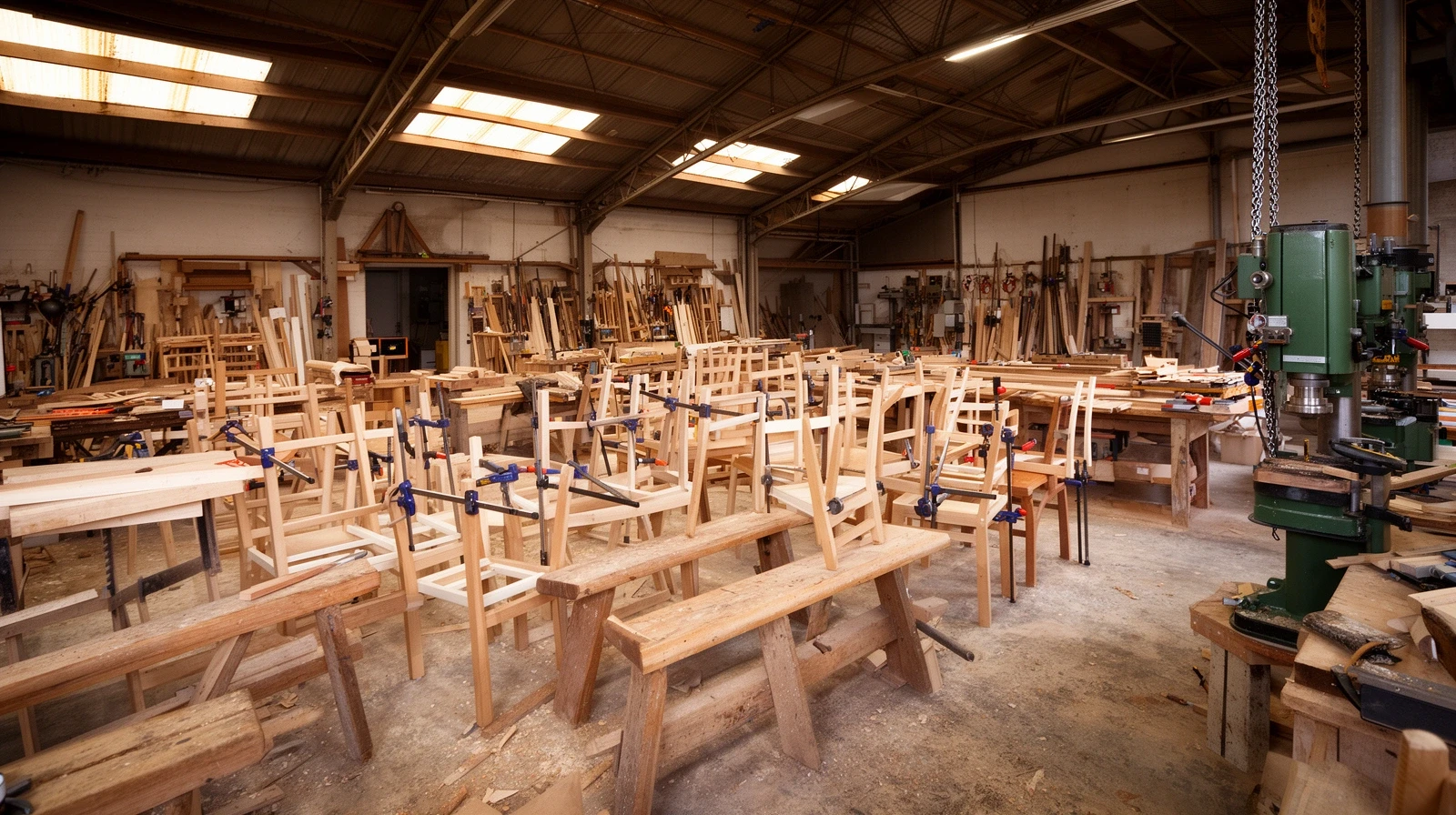
How a chair crosses the room
01
Timber store
Boards come in at 52 mm and sit in the rack for six weeks, stickered, with a meter in them. We cut nothing above 10 per cent moisture.
02
Machine shop
Legs and rails are ripped, planed and thicknessed, then the mortises are cut on a chain mortiser that is older than anyone in the building. Back legs are sawn from one board on a template, never laminated.
03
Benches one and two
Tenons are fitted by hand, one at a time, until the shoulder closes on its own. The frame is drawbored, wedged and cramped up dry before any glue is opened.
04
Test rig
Every dining frame takes the 110 kg seat load and the backrest cycle from BS EN 16139 level 2 before it is finished. Contract frames go on for longer.
05
Finishing room
Three coats of hard wax oil, cut back between each, or lacquer in the booth for contract work. The frame number, timber and date are stamped under the seat and written into the book.
What we run
Second hand English iron where it still beats the new stuff, new machines where it does not.
- Wadkin chain mortiser
- 1962, rebuilt 2024
- Sedgwick planer thicknesser, 12 inch
- daily driver
- Panel saw with a scoring blade
- for seat blanks
- Steam box, 2.4 m
- bent backs and crest rails
- Spray booth with extraction
- lacquer only
- Seat and back test rig
- BS EN 16139 level 2
Things we will not do
- No plywood or laminated back legs, however much cheaper the yield would be.
- No stain to make ash look like oak, or sapwood disappear. If the board is wrong we cut another one.
- No staples in a frame. Upholstery is stapled to the seat platform, which is a different thing.
- No dates we cannot keep. If the walnut has not landed we will say so before you pay anything.
If you want to see the difference, the collection lists what we hold, and care and guarantee covers what happens afterwards.